
Table of Contents
The story of dental implants is one of constant evolution. From early experiments in the mid-20th century to the advanced systems we use today, implantology has continually redefined what restorative dentistry can achieve. But while titanium roots and precision abutments remain the foundation of modern care, the next chapter is already being written — one that combines materials science, biotechnology, and artificial intelligence.
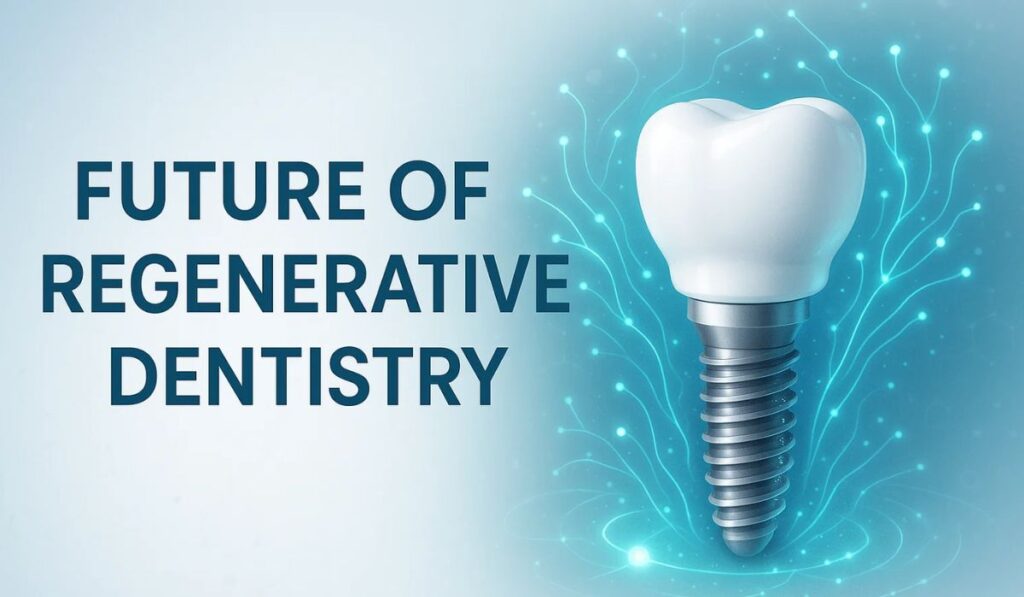
Welcome to the future of regenerative and bioactive implant dentistry.
From Integration to Regeneration
Traditional implant success has long been measured by osseointegration — the stable bond between bone and implant surface. However, the next frontier lies beyond integration: it is regeneration. Future implants are designed not just to anchor passively in the jawbone but to actively participate in tissue repair and healing.
This shift is driven by the development of bioactive materials, capable of interacting with biological tissues at the molecular level. Instead of serving as inert fixtures, these implants stimulate bone growth, accelerate healing, and even release antibacterial agents that protect surrounding tissues.
Researchers are exploring coatings based on calcium phosphate, bio-glass, and hydroxyapatite — all of which mimic the natural composition of bone. By incorporating these substances into implant surfaces, clinicians can shorten healing times and improve long-term stability, particularly in compromised bone conditions.
Smart Surfaces and Nanotechnology
The surface of a dental implant is no longer simply a structural feature; it is a biological interface. Using nanotechnology, manufacturers can engineer surfaces at the atomic level, manipulating topography and chemistry to influence how cells behave.
Nanoscale textures encourage osteoblast adhesion and proliferation, effectively guiding the bone-healing process. Some advanced designs include nano-channels that release bioactive molecules over time, such as growth factors or anti-inflammatory compounds.
These developments transform the implant into a dynamic participant in healing — one that adapts to the biological environment instead of resisting it.
At Edison Medical™, research and development focus on integrating high-precision surface engineering with proven biocompatible materials. Their sand-blasted, large-grit, acid-etched (SLA) titanium implants already demonstrate enhanced bone contact and rapid osseointegration. As bioactive technologies mature, such high-quality foundations will remain critical in bridging conventional and next-generation implant solutions.
Regenerative Biomaterials: Healing Beyond Mechanics
The future of implantology lies in materials that do more than last — they heal. The integration of biomimetic materials, stem-cell scaffolds, and growth factors represents a paradigm shift from mechanical replacement to biological restoration.
Biofunctional coatings embedded with peptides or bone morphogenetic proteins (BMPs) can trigger local bone formation directly at the implant site. Meanwhile, biodegradable membranes and 3D-printed scaffolds guide tissue regeneration, ensuring that both hard and soft tissues recover harmoniously.
This regenerative approach opens possibilities for patients who were previously unsuitable candidates due to poor bone density or systemic conditions. Instead of merely compensating for bone loss, future implant systems may help rebuild it.
Digital and AI-Enhanced Implantology
Alongside material innovation, digital transformation continues to redefine implant dentistry. Artificial intelligence (AI) is becoming indispensable in diagnosis, planning, and even intraoperative decision-making.
AI-driven algorithms can analyze CBCT scans to assess bone density, identify nerve pathways, and suggest optimal implant positions with unprecedented accuracy. They can also predict long-term success rates by comparing patient-specific data to vast clinical databases.
The next evolution involves machine learning feedback loops — systems that learn from every procedure to refine surgical protocols over time. Imagine a workflow where an implant manufacturer’s digital library communicates directly with AI-powered planning software, automatically adjusting design parameters for maximum precision.
Edison Medical’s cross-compatible digital libraries and CAD/CAM integration already lay the groundwork for such intelligent workflows, allowing clinicians to combine digital design freedom with evidence-based accuracy.
3D Printing and Personalised Implants
Additive manufacturing has opened the door to fully customised implant solutions. Using patient-specific imaging data, 3D printing allows the creation of implants and abutments tailored precisely to an individual’s anatomy.
This approach not only improves fit and aesthetics but also enhances biomechanical distribution, reducing the risk of stress-related complications. Titanium and ceramic powders can now be sintered into complex, porous structures that mimic the trabecular pattern of natural bone — encouraging deeper integration and vascularization.
Custom implants are particularly beneficial for trauma cases, congenital deformities, and full-arch rehabilitations where conventional shapes may not suffice. As 3D printing becomes faster and more cost-effective, personalized implantology may soon become standard practice.
Sustainability and Circular Design in Dentistry
Modern dentistry is also facing growing pressure to become more sustainable. The production of titanium implants, while durable, is energy-intensive. Future innovations will likely focus on recyclable materials, local manufacturing, and reduced packaging waste.
Digital workflows already contribute to sustainability by reducing physical models, shipping materials, and redundant remakes. Cloud-based storage and AI-assisted design further minimize data duplication and material waste.
Manufacturers such as Edison Medical are also prioritising ergonomic, mount-less packaging and efficient logistics to streamline the clinician’s experience while lowering environmental impact — a crucial balance as healthcare systems move toward greener operations.
Smart Implants: The Next Leap Forward
Perhaps the most exciting development in dental implantology is the emergence of smart implants — devices equipped with micro-sensors capable of monitoring biological and mechanical conditions in real time.
These implants could measure parameters such as temperature, pH, or loading forces, transmitting data to clinicians via secure wireless systems. Early detection of peri-implantitis, overload, or bone resorption could allow preventive intervention long before symptoms appear.
In the long term, smart implants may even integrate with regenerative biomaterials, responding dynamically to biological signals to release healing agents or adjust mechanical behaviour. The convergence of biotechnology and digital intelligence marks a truly transformative era in oral rehabilitation.
The Human Element: Education and Collaboration
While technology advances rapidly, success in future implantology will still depend on the human factor. Clinicians must master digital planning tools, understand new biomaterials, and apply evidence-based techniques to ensure optimal outcomes.
Collaboration between universities, manufacturers, and practitioners will be vital in translating laboratory research into reliable clinical protocols. Comprehensive training and continuing education will help practitioners navigate this evolving landscape with confidence.
Edison Medical’s commitment to innovation, knowledge sharing, educational content, and transparent quality standards — exemplifies how collaboration fosters progress across the industry.
Conclusion
Dental implants have already revolutionized restorative care, but their journey is far from over. As materials become bioactive, workflows digital, and implants intelligent, the line between artificial and biological restoration grows ever thinner.
In this new era, success will depend on uniting three forces: advanced material science, regenerative biology, and data-driven technology. Together, they promise not only to restore missing teeth but to regenerate living tissue — redefining what it means to heal.
For professionals looking to stay at the forefront of this transformation, Edison Medical™ stands as a reliable partner — combining precision engineering, cross-compatible systems, and a forward-thinking approach to the future of regenerative implant dentistry.